

Key takeaways
- PFAS are widespread, long-lasting synthetic chemicals. Often called “forever chemicals,” PFAS are used in many everyday and industrial products and can persist in the environment and human body for long periods of time.
- PFAS have been detected in tap water across the United States. Research has found PFAS in a significant portion of the nation’s tap water, raising concerns about prolonged exposure and potential health effects.
- Not every water filtration system is designed to reduce PFAS. Look for WQA-certified systems and review the Performance Data Sheet for certified PFOA/PFOS reduction under applicable NSF/ANSI standards.
- Choosing a proven filtration system can help reduce PFAS exposure. Systems specifically tested for PFOA and PFOS reduction, including certain carbon block and reverse osmosis systems, can provide an added layer of protection for drinking water.
In the US, PFAS or “forever chemicals” have been garnering news attention—and it's not hard to see why, given the findings.
A new study by the United States Geological Survey (USGS) finds that nearly half of the nation’s tap water is contaminated by these “forever chemicals”. And with another recent story about 3M's $10.3 billion settlement regarding public water contamination”, it's only natural that controversy around PFAS has increased.
PFAS are definitely concerning—and it's important to be knowledgeable to make informed decisions. So here are the basics about this broad group of chemicals.
What are PFAS?

What are the concerns?
- PFAS break down very slowly, remaining in the environment and in our bodies for a long time. This is why they've come to be known as “forever chemicals.”
- According to the
Environmental Protection Agency (EPA), increased
exposure to PFAS may lead to a variety of health concerns, such
as:
- developmental defects
- increased rate of specific cancers
- increased cholesterol levels
- and more
Do water filters remove PFAS?
Some do and some don't. We always recommend doing extensive research on which water filtration systems remove PFAS.
Finding a product with Water Quality Association (WQA) certification is a great start, since anything with this certification will have gone through rigorous testing to meet the standards set by the National Sanitation Foundation (NSF) and American National Standards Institute (ANSI).
To truly dig into which contaminants a filtration system reduces, look for its Performance Data Sheet. This document can usually be found on the product webpage, or by contacting the company directly. It should clearly state that the filtration system meets certain standards set by the NSF/ANSI. (See the performance data sheets for our Coral and Capella.)
For a proven reduction in PFAS, look for a contaminant in the sheet that says “PFOA/PFOS Reduction” or something similar. PFOA stands for perfluorooctanoic acid and PFOS stands for perfluorooctane sulfonate, and according to the WQA, they are the most widely studied PFAS . If your preferred filtration system targets these PFAS, then you've found a winner.
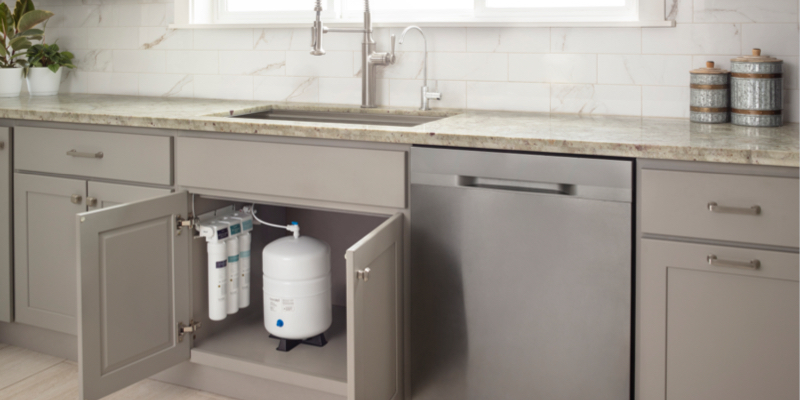
Product in photo: Capella Reverse Osmosis Under Sink Water Filtration System
What are the best water filters for PFAS?
Again, it's important to note that not all water filtration solutions (such as single-carbon filters) are guaranteed for filtering PFAS— it's best to seek out filtration systems that have been rigorously tested for PFOA and PFOS removal. For example, our Coral and Capella water filtration systems are both WQA approved and tested for PFOA and PFOS reduction. What system you choose will depend on your unique needs—Coral features a three-stage carbon block filtration system, while Capella uses reverse osmosis to provide a more extensive reduction of contaminants. To ensure the reduction of “forever chemicals,” shop for a system that has been specifically tested for PFAS under NSF/ANSI 53.
What other progress is there regarding PFAS?
Fortunately, there's some movement within the federal government to help tackle this issue. The Biden-Harris Administration is proposing a first-ever national drinking water standard for six PFAS types. This is a significant step in combating PFAS pollution, and will hopefully progress into further government action to protect our drinking water.
The final takeaway: stay vigilant.
The PFAS issue will take a long time to solve. But with better understanding of these chemical groups, advancements in water filtration technology, and the beginnings of government legislation, we are in a great position to start taking action. Staying vigilant about the water we drink is a great first start—and will only contribute to our greater health down the road.